Thursday, October 23, 2014

Monkeys in Chobe

Monkeys and baboons seemed to be everywhere in Africa that we went, kind of like squirrels and chipmunks in Connecticut. You might not see them in the center of the city amongst the skyscrapers, but they'll be in a park, suburban setting, and of course in rural areas. Once you're in a national park, monkeys and baboons are everywhere.

On our last evening game drive in Chobe, our guides stopped the vehicles by the river near a picnic table and broke out the champagne and hors d'ouevres. The monkeys were waiting for us, with this one already sitting on the table! Of course our guides had warned us not to feed them.


While we were walking around and eating and drinking, a couple of the monkeys decided to see what they could find in our vehicle. The guides have locked metal boxes where they keep the food specifically so the monkeys can't get to it.


They look so cute but can get aggressive when food is around. While I was watching them, one jumped from the ground onto a man in our group who happened to be eating a cracker and grabbed it right out of his hand, practically right out of his mouth!


Here we are with Bea, our guide. The box for the food is behind her.

 
All the guides at the Chobe Game Lodge are women. They are very knowledgeable, friendly, and professional. I can understand why they are referred to as "Chobe angels".


Monday, October 20, 2014

Large Antelopes

There are many different kinds of antelopes in Chobe, from smaller varieties like the impalas and bushbucks to larger ones like kudus, roan antelopes, and sable antelopes. Kudus have several white stripes on their sides and the males have curly horns. The longer the horns, the older the animal. According to Bea, our guide, the male on the right is around two years old because his short horns haven't begun to twist.

 
These lovely specimens are quite a bit older!
 
 
Apparently the kudus don't mind hanging around with smaller animals.


Here are the sable antelopes that were heading down to the river in the heat of the day. During the dry season, you can see how parched the earth looks.

 
We came across this small herd of roan antelopes near the river early one morning.
 

We stopped to watch them and they crossed the dirt road right in front of our vehicle.


I'd say that all these antelopes are approximately the size of horses. Again, so much fun to see "zoo" animals in the wild!


Monday, October 6, 2014

So many animals in Botswana...

We saw so many different animals in Chobe National Park. There were 2 types of mongooses, the banded (striped) mongoose and the slender mongoose, pictured below. Yes, it is kind of slender compared to the banded ones!


There were lots of warthogs wandering around the lodge property. In my subjective opinion, they are not very pretty animals. I don't think we ever got a good photo of their faces.


There were lots of Cape buffalo in Chobe too. I guess I would include them in the same category as the warthogs, although they do have impressive horns. Like the warthogs, they also seem calm and peaceful.


We saw vicious predators like this crocodile which looks pretty harmless sunning itself on the riverbank. Mark estimated it to be more than 8 feet long. African crocodiles are apex predators, meaning that they are on the top of their food chain.


This monitor lizard blended into the grass perfectly--I think we only noticed it once it began walking. I'd guess that it was at least 4 feet long.

 
We saw zebras in Chobe but the herds were not as large as I had hoped to see. I love their black and white stripes!
 
 
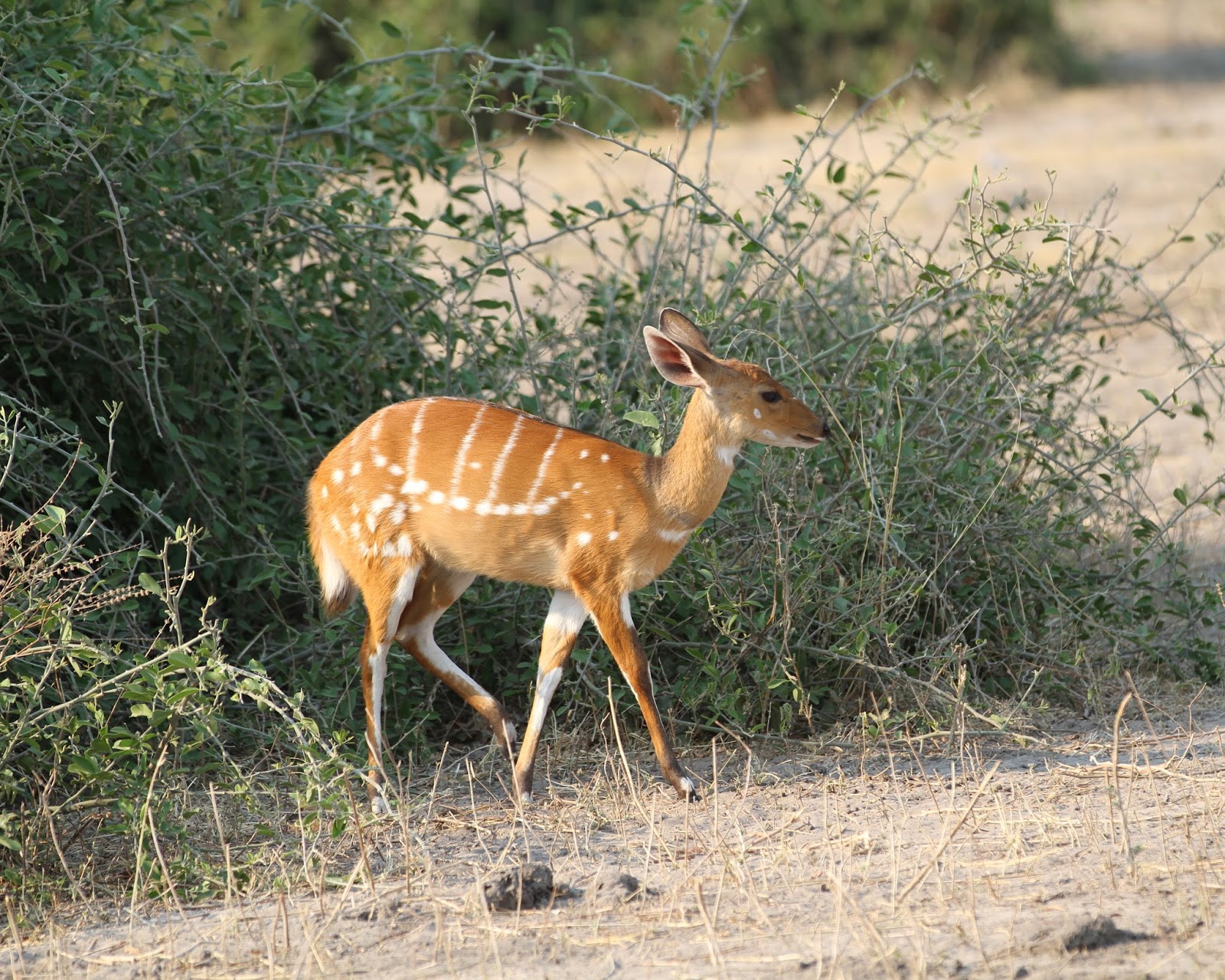
We even got to see a bushbuck, which is a smaller member of the antelope family. Unlike most antelopes, bushbucks are solitary animals that do not form herds.
 

These animals all had excellent camouflage for their habitat. Whenever we noticed them standing still at a distance, they actually were hard to see with the sun and shadows of the grass and bushes.


Sunday, October 5, 2014

Impalas in Chobe

Impalas are among the smallest and most common of the antelope species in Africa.  Our guide Bea said they are jokingly referred to as "McDonald's" for several reasons. One is that the black markings in their tail area actually look like an "M".


Another reason is that they are everywhere and there are just so many of them! We came across this herd near the river early one morning. They are considered "fast food" for the lions.

 
Males are roughly 3 feet tall at the shoulder and only the males have horns.
 
 
Look at the sweet face on this female!
 
 
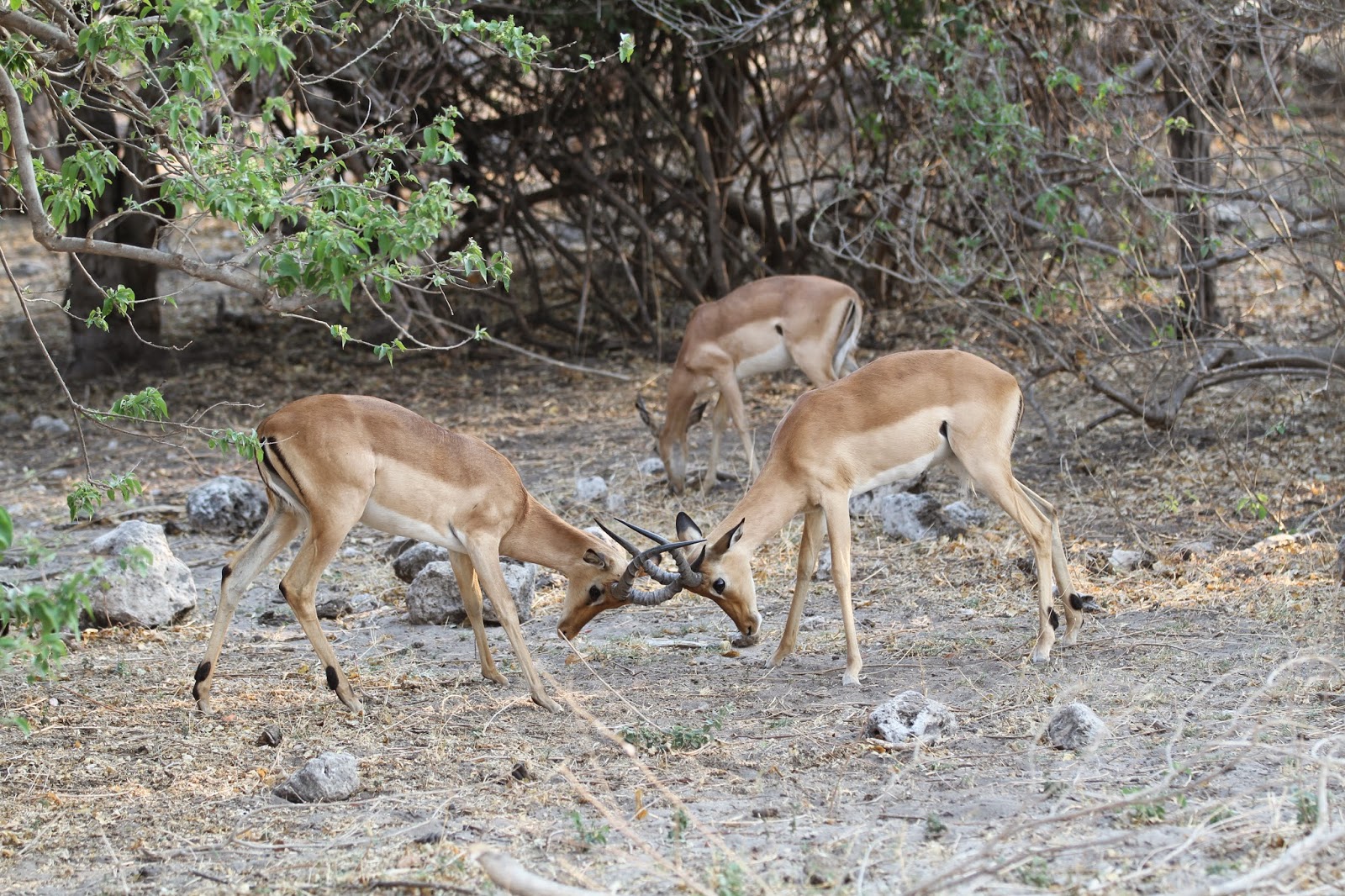
These young males were practicing their fighting skills. We knew we would always see some impalas on our game drives, but we always enjoyed it.


.

Thursday, October 2, 2014

I Love Giraffes!

Giraffes are amazing animals. We would be out driving somewhere and all of sudden you'd see a head sticking above the trees--a giraffe! They are gentle giants who often stopped eating to watch us as we watched them. Because of their size, they don't seem afraid of humans but would often come closer to our stopped vehicles.  I think they were curious.

One giraffe decided to cross behind our vehicle to go munch trees on the other side of the road. The grass is always greener on the other side? The landscape looked the same to us.
 
They have such long eyelashes!

 
During one early morning game drive, we came across this pair near the river.

 
They each have very distinctive spots--this one had especially unique patterning. The darker color spots mean that he is a mature giraffe.

 
I thought the zebras would be my favorite animals in Africa, but I like giraffes even more. One of my earliest toys was a large vinyl giraffe--I can still remember the smell of the vinyl and the bright colors of the spots--but real live giraffes are even better!


Wednesday, October 1, 2014

Lions

On our last morning in Chobe, we saw lions on the game drive! One lioness was relaxing in an open area near the river. The flock of guinea hens walked right by her.

Soon she was joined by another lioness.

On the other side of our vehicle we could see a third lioness and two cubs under some brush. With the cubs playing in the shade I knew it would be impossible to photograph the scene. Then someone noticed a lion in the background. His head was barely visible beyond the greenery--the brown that you see in the center of the photo is his mane.


I was able to see his profile when he turned his head! The males are even more reclusive than the females so we were lucky to see him. Our guide had warned us to stay sitting when and if we saw lions--apparently they view the whole vehicle as one large thing, but if a person were to stand up they would perceive him as an individual--and likely prey! We all followed those directions perfectly.

Hippos

Hippos look like such benign creatures lounging in the river up to their eyeballs, but they are dangerous animals. They are very territorial and can move surprisingly fast for their size. Whenever our boat got close to them, they would watch us and then open their mouths to show their teeth if they wanted to warn us to keep our distance.

One afternoon a herd of sable antelopes came down to the river for a drink and headed straight for the spot where the hippos were lounging.

The hippos were not happy and they began to show their teeth and grunt.  One brave antelope kept moving toward the river and the alpha hippo went right up on shore.

The antelope decided to take a sip from a small watering hole instead of going to the river.

That hippo went back to the river and began to tussle with the other hippos. There was a lot of showing of teeth and bumping each other but it didn't look like serious fighting, more like "Who da man?  I da man! I showed that antelope who's boss!"

 
Sometimes hippos just lounge around looking mellow, like this pair. Now these are the kind of hippos I like! They were on the other side of the river from the previous photos, which is not Botswana but another country:  Namibia!