Wednesday, October 29, 2014

In Memory of Dad

 
Walter Nadolny
May 8, 1916 - October 29, 2005
 
A kind and honest man who loved his children and grandchildren,
God and his country


21st World Orchid Conference in South Africa

We traveled to Africa with RF Orchid Tours to attend the 21st WOC in Johannesburg. Held every three years, the location of the World Orchid Conference varies. Mark and Dawn went to the 19th WOC in Miami six years ago, and then they went with RF Orchid Tours to the 20th WOC in Singapore. About half of the people in our tour group went to Singapore.

In Johannesburg, we stayed at the Sandton Towers which was conveniently connected to the Convention Center. We enjoyed the orchid show but the general consensus was that it was smaller and less impressive than the Singapore show. RF Orchids was the only American grower that exhibited. Bob Fuchs came away with quite a few ribbons!

 
The exhibition halls opened after speeches at the Opening Ceremony on September 9th. One of the highlights of the evening were two lovely models wearing gowns covered with live orchids.

The Thai orchid growers had a huge display running the length of the exhibition hall.
 

One of our favorite displays was "The Botanist's Study" designed by a South African orchid club.

The variety of orchids and quality of the specimens on display was amazing!


Friday, October 24, 2014

Birdwatching in Botswana

On a group tour to the World Orchid Conference, who knew that so many of our fellow travelers were avid birdwatchers? Plenty of "ooohs" and "aaahs" whenever our guide pointed out birds, and the serious telephoto lenses came out to take bird photos!

An African starling looks very different from our local starlings who have dull black feathers.

Remember Zazu from The Lion King?

This is what a red-billed hornbill looks like in real life! They are quite spectacular in flight when their long tail feathers fan out.

African guides watch vultures to learn where there might have been a recent kill.
 
The lilac-breasted roller is a small bird with very long and thin tail feathers.

This roller is getting ready for takeoff--such gorgeous plumage! There are a couple of very thin black feathers that extend beyond the blue tail feathers.
 
This kingfisher was resting near the river one hot sunny afternoon.
 
A yellow-billed stork
 
A marabou stork
 
We saw plenty of fish eagles near the river.
 
We even saw a golden-backed eagle with a fresh kill.
 
There were plenty of other birds at Chobe too--cormorants, egrets, plovers, guinea hens, and many different kinds of ducks and geese. Africa is just teeming with life! I think Mark has a calling as a wildlife photographer...most of the photos I have been posting are ones he took with his Canon and supertelephoto lens. 


Thursday, October 23, 2014

Baboons in Botswana

After being ferried across the Zambezi River from Zambia into Botswana, our group got into 4-wheel drive vehicles for the ride to Chobe Game Lodge. One of my favorite parts of our trip to Africa was seeing wild animals alongside the road, and this family of baboons crossed the highway in front us shortly before we entered Chobe National Park. The highways in Zambia and Botswana were 2-lane paved roads--these are countries where the few roads are typically dirt.

 
There were lots of baboons near the lodge and we always saw more on game drives or boat trips on the Chobe River. Here's a mom with her new baby and her toddler is trying to hug the baby!
 
 
The baby holds onto mom for dear life when she goes for a walk. Our guide says when the baby gets bigger, he will ride on his mother's back.
 
When mom stops, the baby climbs down!
  
I'm not sure what this young baboon is looking for in the grass--bugs maybe?

Time for some grooming while relaxing in the shade.

 
This family is romping near the river. 


One of the large males came down to the river for a drink while our boat floated by.

 
The baboons were fascinating to watch wherever we saw them!


Monkeys in Chobe

Monkeys and baboons seemed to be everywhere in Africa that we went, kind of like squirrels and chipmunks in Connecticut. You might not see them in the center of the city amongst the skyscrapers, but they'll be in a park, suburban setting, and of course in rural areas. Once you're in a national park, monkeys and baboons are everywhere.

On our last evening game drive in Chobe, our guides stopped the vehicles by the river near a picnic table and broke out the champagne and hors d'ouevres. The monkeys were waiting for us, with this one already sitting on the table! Of course our guides had warned us not to feed them.


While we were walking around and eating and drinking, a couple of the monkeys decided to see what they could find in our vehicle. The guides have locked metal boxes where they keep the food specifically so the monkeys can't get to it.


They look so cute but can get aggressive when food is around. While I was watching them, one jumped from the ground onto a man in our group who happened to be eating a cracker and grabbed it right out of his hand, practically right out of his mouth!


Here we are with Bea, our guide. The box for the food is behind her.

 
All the guides at the Chobe Game Lodge are women. They are very knowledgeable, friendly, and professional. I can understand why they are referred to as "Chobe angels".


Monday, October 20, 2014

Large Antelopes

There are many different kinds of antelopes in Chobe, from smaller varieties like the impalas and bushbucks to larger ones like kudus, roan antelopes, and sable antelopes. Kudus have several white stripes on their sides and the males have curly horns. The longer the horns, the older the animal. According to Bea, our guide, the male on the right is around two years old because his short horns haven't begun to twist.

 
These lovely specimens are quite a bit older!
 
 
Apparently the kudus don't mind hanging around with smaller animals.


Here are the sable antelopes that were heading down to the river in the heat of the day. During the dry season, you can see how parched the earth looks.

 
We came across this small herd of roan antelopes near the river early one morning.
 

We stopped to watch them and they crossed the dirt road right in front of our vehicle.


I'd say that all these antelopes are approximately the size of horses. Again, so much fun to see "zoo" animals in the wild!


Monday, October 6, 2014

So many animals in Botswana...

We saw so many different animals in Chobe National Park. There were 2 types of mongooses, the banded (striped) mongoose and the slender mongoose, pictured below. Yes, it is kind of slender compared to the banded ones!


There were lots of warthogs wandering around the lodge property. In my subjective opinion, they are not very pretty animals. I don't think we ever got a good photo of their faces.


There were lots of Cape buffalo in Chobe too. I guess I would include them in the same category as the warthogs, although they do have impressive horns. Like the warthogs, they also seem calm and peaceful.


We saw vicious predators like this crocodile which looks pretty harmless sunning itself on the riverbank. Mark estimated it to be more than 8 feet long. African crocodiles are apex predators, meaning that they are on the top of their food chain.


This monitor lizard blended into the grass perfectly--I think we only noticed it once it began walking. I'd guess that it was at least 4 feet long.

 
We saw zebras in Chobe but the herds were not as large as I had hoped to see. I love their black and white stripes!
 
 
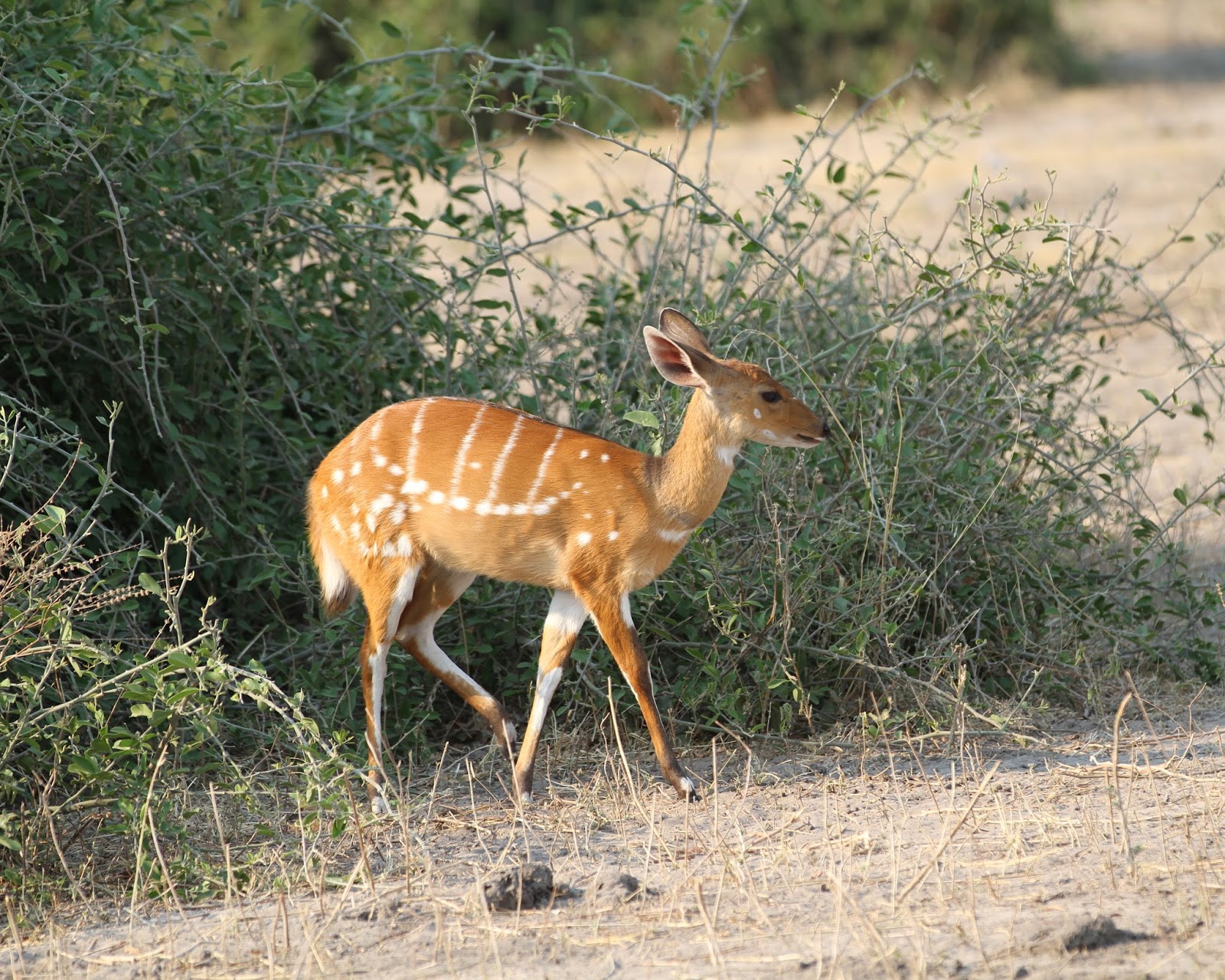
We even got to see a bushbuck, which is a smaller member of the antelope family. Unlike most antelopes, bushbucks are solitary animals that do not form herds.
 

These animals all had excellent camouflage for their habitat. Whenever we noticed them standing still at a distance, they actually were hard to see with the sun and shadows of the grass and bushes.